Glimpse issue #55, Spring 2022, which contains my poem “I am throwing away” is now available in an electronic version at the magazine’s website.
The 2022 blog post announcing my receipt of the hard copy appears here:
link
Glimpse issue #55, Spring 2022, which contains my poem “I am throwing away” is now available in an electronic version at the magazine’s website.
The 2022 blog post announcing my receipt of the hard copy appears here:
link
The poem, “A Stone,” appears at Wise Owl, their Daily Verse feature, 28 April 2025.
I couldn’t figure out a way to link directly to “A Stone,” so I’ll just have to recommend following the link and scrolling down to 28 April.
You might notice I put “ouch” in parentheses next to the title in the heading for this post. I decided to title a number of similar poems “A Stone,” so I will add a distinguishing word beside the title sometimes. Why don’t I just use a different title? I’ve seen other poets do something similar — Frank O’Hara titling many of his poems “Poem,” for instance. When “Poem” is referred to elsewhere it needs help with identification. “Poem (lousy).” “Poem (anthology piece).”
I have an idea. I am experiencing ideation.
Am I ideating? Do people like to ideate?
Ideas. Where do they come from? One is probing my noodle right now.
I think it wants to use me for its own purposes. Or perhaps it wants to escape my head.
I don’t think the idea is mine. I think it is on its own, seeking someone to use.
But what is it, exactly? What am I experiencing? I close my eyes. But my eyes won’t stay closed. I could continue to write with my eyes closed. I try it briefly, and I don’t make it to the end of the sentence before the eyes pop open. They see what they already knew would be there. But what if what was there was the idea that is seeking a vehicle for expression?
I have had ideas that want to be used. Some of them want to be abused. Is that when I am ideating — when I am thwacking an idea with a switch?
I would ideatize. I shouldn’t be so abstract. I should idealate. I could stand on a chair and be a concrete detail, my feet in socks on the slippery vinyl seat. I could also call upon my ideativity, raise a horn to my lips and blow. The vibration of the sound makes my lips itch.
What’s the idea? I suppose it is open, that I am scooping into its resistant flesh. If I look closely enough, perhaps with the right peering equipment, I will descry the operating mechanism or the operating principle. Perhaps I will see its song, the vibrato making it a blur.
Maw Shein Win edits a column called “Process Notes” for Periodicities, an online magazine about poetry.
Each month Maw lines up a poet to talk about their new book, how they came to write it, the way they went about it, etc. When she asked me to contribute a note about writing Autobiography of a Book, Maw said the column focused on poetry, and Autobiography of a Book is prose, but she thought it was poem-like and was curious to read a discussion of my process.
This is the first paragraph of my process note:
When Book came to me several years ago, it came to me the way my poems often do, with a little idea that, when I hit the keyboard, began to play, and the more it played itself through me, the more that little idea turned out to have different facets, different approaches, even different rules. That’s how poetry works for me, as play. Even when the poem addresses a serious topic, I engage playfully. Poets are supposed to learn all the rules before they break them, or so the advice goes, and in classes I did dutifully bang away at sonnets, iambic pentameter, all that. But counting stresses me out. Some claim that for them constraints are freedom. But shackling myself with preconceived notions does not liberate my mind. English by itself, I always say, is a constricting form. And so, poetry. I wouldn’t be writing poetry if poetry meant strict rhyme and meter. For me, poetry means experimentation, investigation, invention, play. That’s freedom.
You can read the rest at periodicities: a journal of poetry and poetics.
Richard Loranger, an Oakland poet and friend, sent out an ask for A New Pledge, something to update the hand-over-heart salute to the flag you remember from grade school. This is the one I offered:
I pledge allegiance to the love
that gets us through the night,
and to the compassion
that lends a hand,
even to the hate-filled and ignorant,
and to such friendship freely offered
as brings together
work of justice and play of freedom
forever, for all
*****
I still have the old pledge memorized, so the words and the rhythms of it were called up. The other night, lying in bed, a first line came, then a second, and so on. Rare that I write a poem in my head and then go to the page.
Read the growing page of pledges at I Need a New Pledge. Richard says he will continue to add to it as pledges are sent to him.
Summer, Fall, Winter
Like Costco toilet paper
Bulk products run low
My husband Kent wrote the occasional poem. In this case it’s the very American version of haiku, the 5-7-5 syllable count what makes it haiku. Kent does refer to the seasons, which is considered another requirement of Japanese haiku. The Japanese want a haiku to evoke the feeling of a particular time of year. Does Kent’s? Perhaps the poem means to evoke winter -- the “bulk products” of nature are abundant in summer, but gradually peter out in fall, winter offering the smallest amounts.
Kent appends a note, “3 season Haiku.” Was that was the challenge? Write a poem that includes three of the four seasons?
Every so often I sort a pile of papers and today I found the haiku on a crumpled square of paper from a logo notepad. It is undated.
Big Windows Review has posted the poem
I had a poem in Big Windows back in 2019: “you have come to a certain place”
Cobalt Weekly has posted the poem
The editors are closing up the weekly, but, they say, they will still be publishing books.
Five poems appear in #Ranger, issue 4, spring 2024:
“another well recently intercepted”
#Ranger’s motto: “Art that’s not vanilla”
A print issue will be available this summer print-on-demand from Lulu.
Berkeley Poetry Review, issue #52: When the World Moves On, contains two of my poems:
“A Window”
“A Wind Is Blowing”
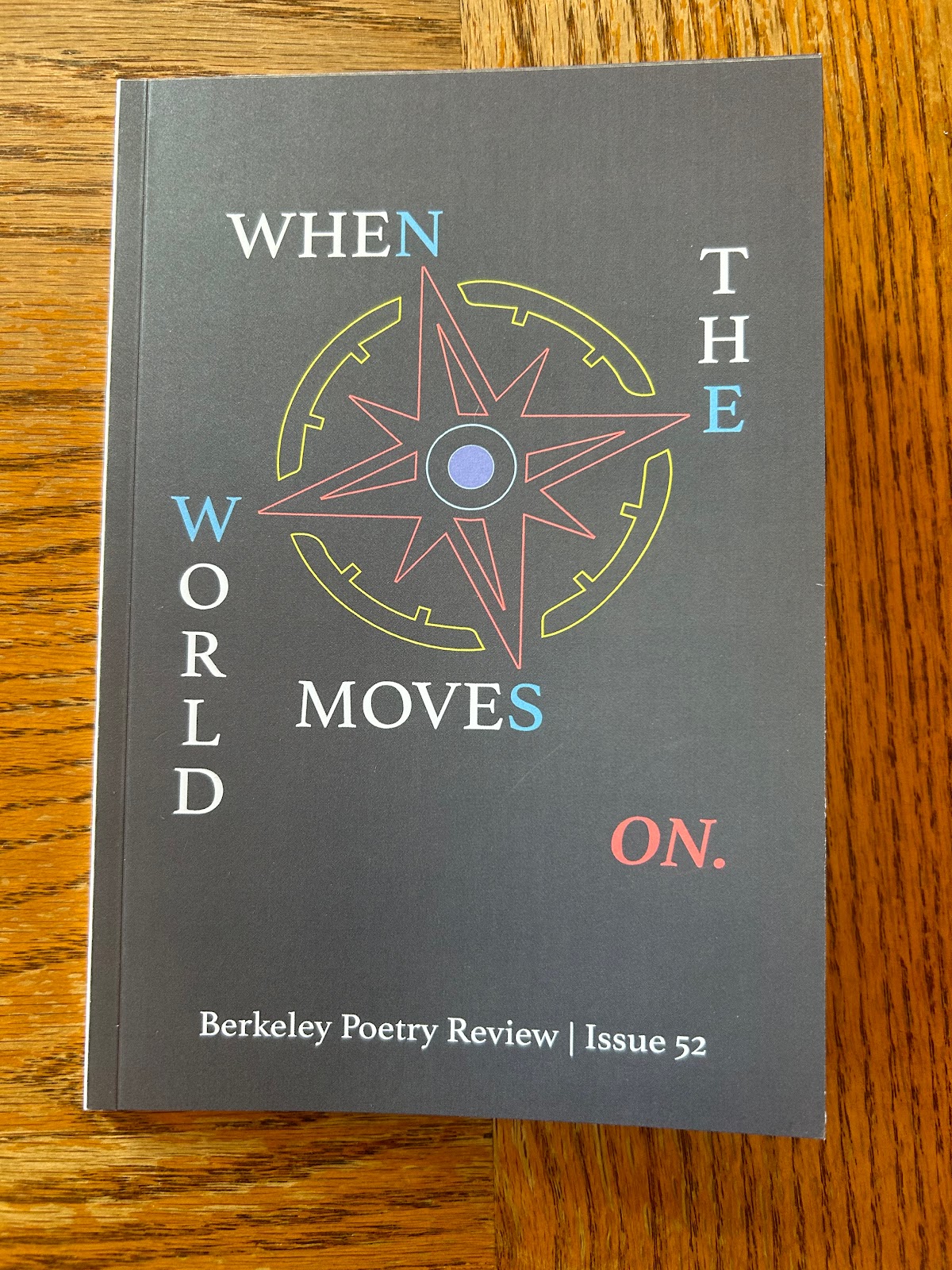


This is the first time I’ve had a poem in BPR since I was on staff back in the early 90s. BPR can change greatly from year to year. It’s a student-run publication, thus whether enough students show up will determine whether there is a BPR in a year. Some years, nothing. In this academic year the staff seems to be promising two issues. They are currently open for submissions.
If you would like to read issue #52 online — or want to download the whole thing — you can do so at this link.
That magazine published those poems because the editors liked them. The editors got other poems that I know I would have liked — and perhaps would have liked better than anything I saw in their magazine — and the editors chose against them.

Autobiography of a Book is the life story of a book. The book must will itself into existence. And by “will” I mean talk. The book must talk until it comes to its end. With every word Book edges closer to its dream, its dream of being what it claims to be, a real, honest-to-goodness book.
Can a novel that anthropomorphizes language be a page-turner? Glenn Ingersoll’s Autobiography of a Book says, “Yes!” And this reader agrees.
— Eric Darton, author of Free City
Book came to me as a voice and demanded I type as it spoke. I usually scoff at people who claim their writing is dictated by the muse, so I find it funny to be saying something like that myself. But Book is a character, in both senses of the word, and I was ready to listen and to work. Whatever it said, I was happy to go along.
Book is imbued with the longings of a body, the vulnerable reality of a Frankenstein’s Monster or a Velveteen rabbit, the pangs of creator and created, and all the fragile, vigorous, shambolic longings of humanity. To read Ingersoll’s wildly inventive prose debut is to be transformed.
— Maw Shein Win, Storage Unit for the Spirit House
Book and I both wondered during the process if a respectable book length would actually be achieved. At roughly 44,000 words, 220 pages, I think it did. Is that short for a novel these days? Not that “novel” is necessarily the right word. I struggle with how to characterize Book. There's nothing fictional in it. Everything Book says happened because Book is all language and anything Book says is undeniably Book, even if impossible. Does Book have human arms and legs? Yes, when Book finds it convenient to imagine so; when imagination is defeated, Book borrows the reader’s hand, the reader’s heart.
It’s quite a magic trick to read something totally original that also echoes something inside.
— Shannon Wheeler, New Yorker cartoonist, creator of Too Much Coffee Man
Also unlike a novel (perhaps like a life?), Book does not have a plot. Book has ideas, actions. Book has thoughts and more thoughts and tries to work them out. Book’s parts often read as essays. Perhaps that’s the way Book would be most properly classified — as a collection of personal essays, the personal essays of someone whose person is no more (somehow more?) than those essays.
"Those who fear the novel is dead or dying can rest easy. Between the pages of this revelatory revenant—the art form revivified with heart, humor, and layered perception—is a bildungsroman of a book, literally. Think Italo Calvino. Think David Markson. Now remember Glenn Ingersoll."
— George Salis, author of Sea Above, Sun Below
Because the essays usually read as separate propositions I submitted them in small batches to literary magazines and ezines, in hopes editors would like them, and think them sufficient in themselves. Sixteen did. One editor even nominated for the Pushcart anthology.
So a book walks into a bar with an identity crisis…, and fractals through one hot, exercised imagination. It’s like Gertrude Stein’s hair setting itself on fire in a crowded theater. What fun! Long a fanatic for Ingersoll’s poetry so no surprise this epic is a stunner. Absurdly original and far out, this baby steams along toward its very sublime amen with muscle, pathos and love.
— Michael Martin, award winning poem-filmmaker and author of Extended Remark: Poems from a Moravian Parking Lot
Please follow these links to journals that include Autobiography of a Book excerpts, most of them online:
It does no disservice to Glenn Ingersoll to call him the author of the exhilarating Autobiography of a Book, but doing so might be taken as an offense to the Book, which is, as we discover, self-authored, as is the case with so many great works of literature. “Life begins with an utterance. A word. Another word to grow on. A third to give the first two meaning. One more and we begin to have context. We are now in the midst of it. This is living.” Thus the Book begins. Already both its charmingly quirky personality and its erudite intellectual acumen are in play. The Book does not censor its flow of anxieties nor disguise its capacity to be amused at its failings even while remaining committed to its existence; it is imaginative enough to be willing to venture into (and experience) dark and even dangerous scenarios, and (of course) to linger in and fret over its intimate relationship with words and their organization into sentences. Book, after all, has no other existence. Having an existence, meanwhile, means it has context; it inheres in a world—its world—of experiences. It is thus that it accrues personality: “[R]egardless of whatever creation, work of art, or deed has come about, someone has lived. Are we someone? Are you someone? Try to be someone!” So writes Julia Kristeva in the preface to her biographical Hannah Arendt, but it’s something that the Book too might say. Listen well.
— Lyn Hejinian, author of My Life and The Cold of Poetry
Why does the smell of books captivate us so much—that particular combination of paper, ink, glue? Because it’s the scent of imagination and possibility, when, as this book tells us, “I am so new. I am just starting… I am such a promising young thing… Anything could happen.” Including the book in your hands addressing you directly—yes, you, the person reading this blurb! “Dear reader, I need you. When it comes down to it, I want to live. When I am read, I live.” The best part? As you read life into this book, it returns the favor. First it’s your child, then your lover, then you’re switching places, then—but I can’t, I won’t give away the wondrous secrets inside. You’ll never look at a book the same again.
— Hardy Griffin, founding editor of Novel Slices
Witty Partition (formerly The Wall)
[thank you to the editors for the Pushcart nomination]
Book is quite a character and a likable one. I now even think of Book as a friend.
— Alan Bern, author of Waterwalking in Berkeley
You are now reading a blurb endorsing the gloriously inspired Autobiography of a Book — as told to Glenn Ingersoll. This book wants to know you as intimately as only a book can. This book wants to live in your library with your collected books. Maybe in your biography section. Consider this non-fiction, as it is the true testimony of the book you now hold. It may not speak for every other book, but it offers an incredible journey deep into the pages of itself unlike anything you’ve read before.
—James Cagney, author of MARTIAN: The Saint of Loneliness, winner of the 2021 James Laughlin Award from Academy of American Poets
At the core of its winding soliloquies, witty, surprising, in which it muses, complains, splits, burns, gods, the book asserts that you, its 'dear reader', give it life and that it in turn wants nothing more than to pulse its life back to you.
— Richard Silberg, author of Nine Horses and Associate Editor of Poetry Flash
"I love promising. I love imagining. I am ready to offer myself." So says the eponymous book of this book. In an age of high-falutin’ memoir and auto-fiction, Glenn Ingersoll's ingenious Autobiography of a Book pleases with its freshness and naivete, its openness to the world that it comes into. It is a book about being and speaking and wonder. It is a book about the making of a book. How do books exist for us — and we for them? How do we exist for ourselves? Autobiography of a Book teaches as it entertains, provokes and — quite literally — entrances.
—Katy Lederer, author of Pokerface: a girlhood among gamblers and The Heaven-Sent Leaf
In 1644, in Areopagitica, the Puritan poet, John Milton announced that “books are not absolutely dead things, but doe contain a potencie of life in them.” In 2022, the American poet, Glenn Ingersoll has taken Milton’s notion––not to mention the later notion of “the death of the author”––one step further. What if a book awakened and began to speak, to write itself? Autobiography of a Book is an I-based production, but this “I” is not a human author: this “I” is an object, a thing made of paper and words, written words. If a human life begins with a breath, a book’s life “begins with an utterance. A word.” But the book is not “finished”: like a human, it must develop, it must explore infinite possibilities. “I am so new. I am just starting.” Ingersoll’s brilliant concept results in a book about almost everything, including pages “left intentionally blank.” It is, as the book itself tells us, “more idea than construct, more spirit than body.” It is also one of the most delightful and original reads of any season. Who needs an author when one has a book?
—Jack Foley, author of Visions & Affiliations: A California Literary Time Line and Eyes: Selected Poems
The curated reading series Quiet Lightning also included an excerpt that was previously published in Hawai’i Pacific Review.
fresh.ink has reprinted the chapters that originally appeared at Hawai’i Pacific Review.
A fascinating journey! But take courage, whoever opens this book. What begins as a bizarre and charming conceit -- letting the book write itself -- morphs into a true-pitch recording of the subtext running underneath, well, everything. It’s uncanny. Even running underneath everything I do. Bringing into view all manner of creativity, any creativity, any motion, any act, and then calls into question their value, without ever stating that’s what it’s doing. Are these demons of my own device? Are they truly running underneath everything? Can you continue without dealing with the questions? I did write “courage,” and that is what I meant.
—Clive Matson, author of Mainline to the Heart and Let the Crazy Child Write! finding your creative writing voice
**
Book and I thank the editors of these journals for giving Book life. Editors provide readers an opportunity to read something new, and even when editors choose against a particular poem, story or essay, an editor has to read it to make that choice. Every editor is a reader. When Book is read that is when Book really lives. That is the true life of Autobiography of a Book — a reader making it part of theirs.
[See a June 2020 post for an earlier version of this introduction to Autobiography of a Book.]
